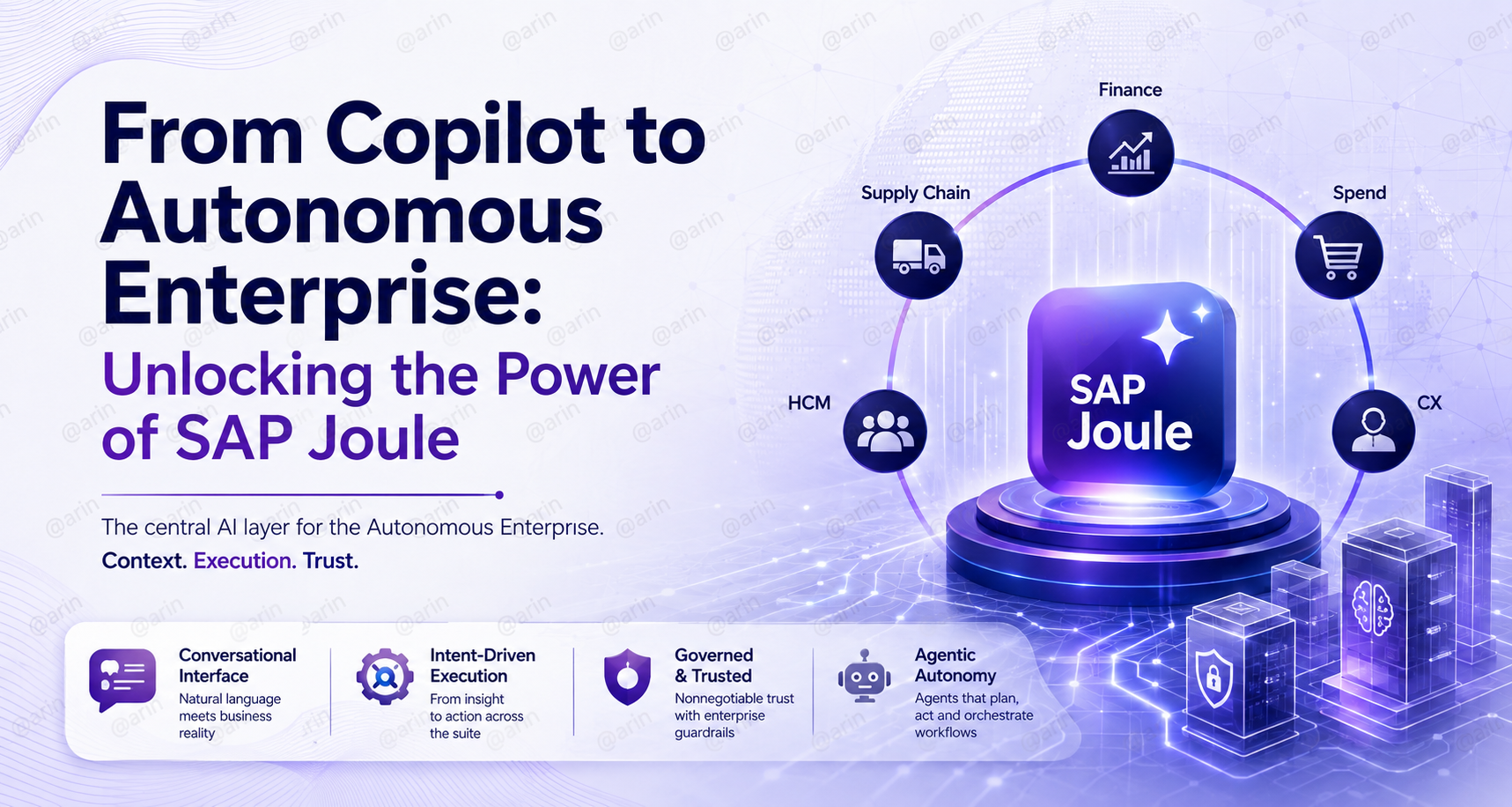
From Copilot to Autonomous Enterprise: Unlocking the Power of SAP Joule

The conversation around enterprise AI has shifted. We are moving past the initial novelty of “chatting with a PDF” and entering an era where AI is expected to actually do the work. For the modern organization, the challenge isn’t a lack of AI models; it is a lack of context. Generic AI guesses don’t run payroll or optimize a global supply chain. In the current landscape, the competitive advantage is no longer found in having access to Large Language Models (LLMs), but in how those models are grounded in the specific, messy, and complex reality of business operations.
This is where SAP Joule enters the frame. Joule isn’t just another chatbot; it is the central engagement layer for the next generation of business operations. It represents a transition from AI as a sidekick (a copilot) to AI as a primary orchestrator of enterprise value. To understand the scale of this shift, one must look beyond the interface and into the architectural transformation SAP is undertaking to move the global economy toward a state of total operational autonomy.
Section 1: Introduction to SAP Joule
SAP Joule is a natural-language, generative AI business assistant designed to act as the primary interface between the user and the vast complexities of the SAP cloud portfolio. While many AI assistants function as surface-level overlays—essentially wrappers around a public LLM—Joule is deeply integrated into the business logic of the enterprise.
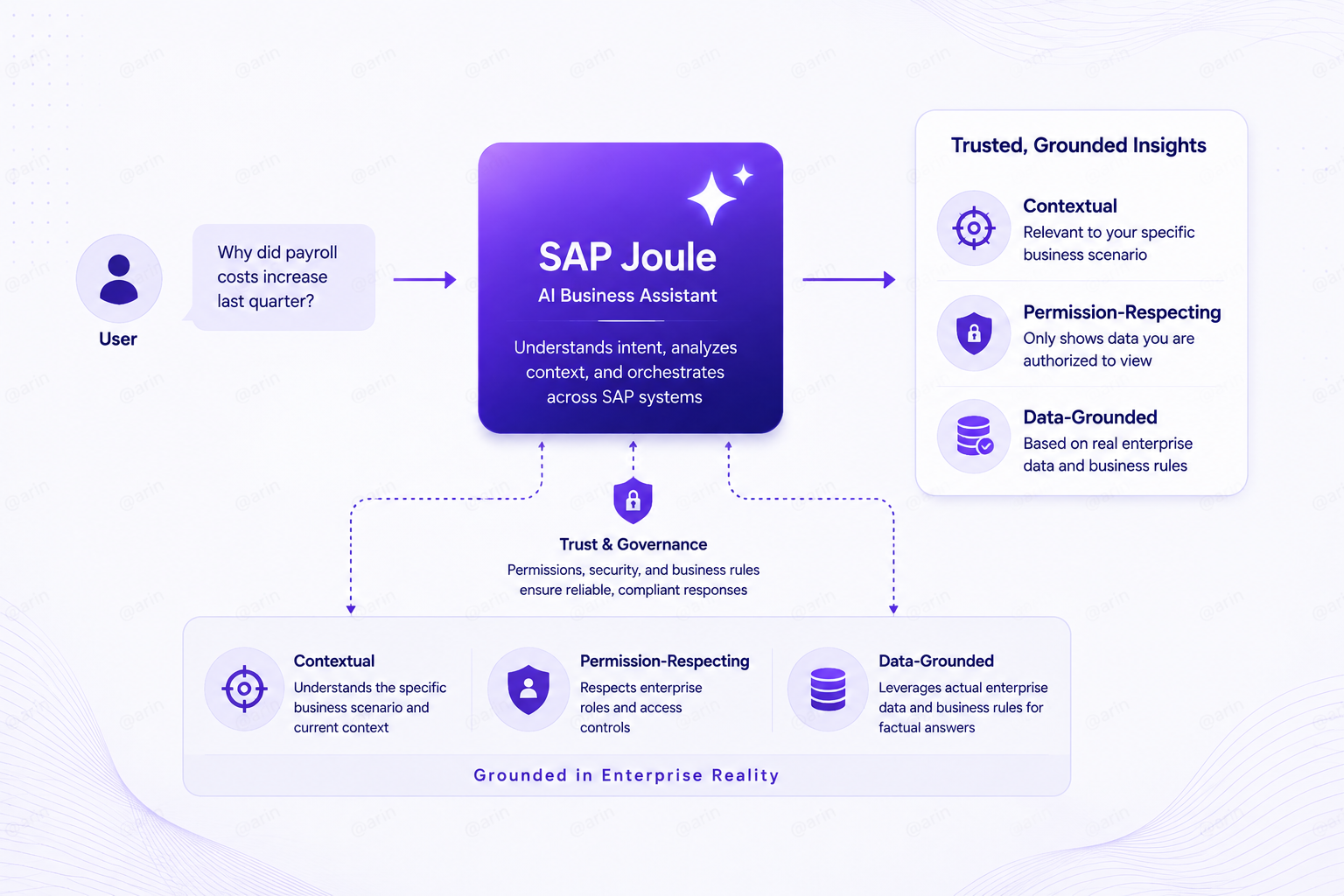
Unlike general-purpose LLMs, Joule’s primary value proposition is its grounding in business reality. This “grounding” prevents the hallucinations common in generic AI by ensuring that responses are based on actual system data and business rules. In a corporate environment, a hallucination isn’t just a quirk; it is a compliance risk. By tying the generative output to a deterministic record, SAP ensures that Joule provides insights that are:
-
Contextual: It understands the specific business scenario the user is in. For example, if a user is looking at a specific purchase order in S/4HANA, Joule knows the context of that order without the user needing to re-explain it.
-
Permission-Respecting: Joule adheres to existing enterprise security and access controls; it will not surface payroll data to a manager who does not have the authorization to see it.
-
Data-Grounded: It leverages actual enterprise data to provide factual answers rather than “AI guesses”.
In essence, Joule transforms the user experience from a search-and-click exercise into a conversational dialogue. Instead of navigating through multiple screens to find a discrepancy in a financial report, a user can simply ask, “Why did payroll costs increase last quarter?” and receive a reasoned answer based on real data.
Section 2: Where Joule Sits: The Ecosystem and Integration
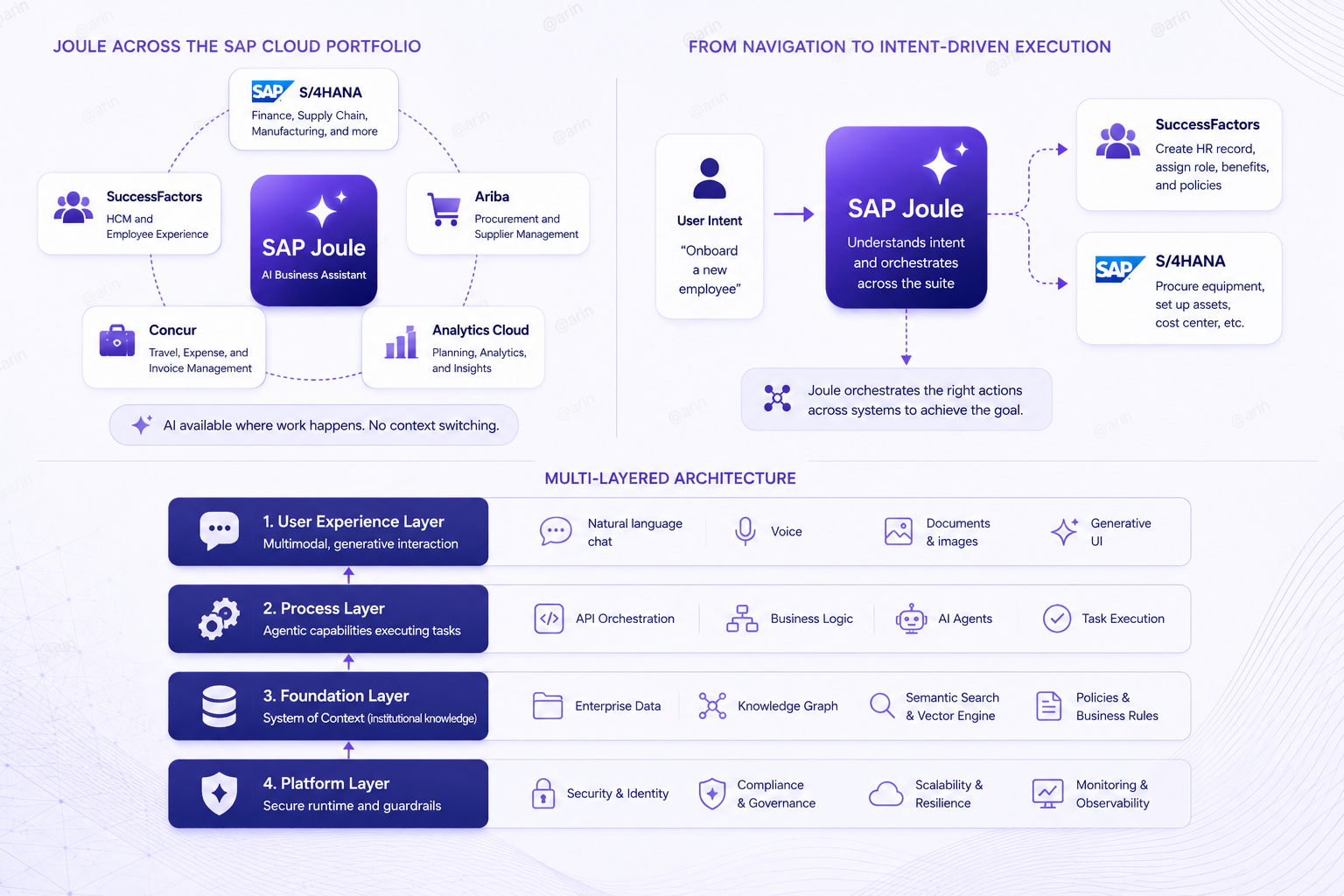
Joule is natively embedded across the SAP Cloud portfolio, including S/4HANA, SuccessFactors, Ariba, Concur, and Analytics Cloud. This omnipresence ensures that AI is available exactly where the work is happening, eliminating the “context switch” that often plagues productivity.
Architecturally, Joule represents a fundamental shift in the “Cognitive Core”. We are moving away from static application navigation toward intent-driven execution. In this new model, the user expresses a goal in plain language (the “intent”), and Joule orchestrates the necessary steps across the suite to achieve it. For instance, a request to “Onboard a new employee” might trigger actions across SuccessFactors (for HR records) and S/4HANA (for equipment procurement).
This integration is supported by a multi-layered architecture:
-
The User Experience Layer: Where multimodal, generative interaction occurs.
-
The Process Layer: Where agentic capabilities execute tasks via APIs and business logic.
-
The Foundation Layer: The “System of Context” that stores institutional knowledge.
-
The Platform Layer: The secure runtime that ensures the AI operates within corporate guardrails.
Section 3: The Path to the Autonomous Enterprise
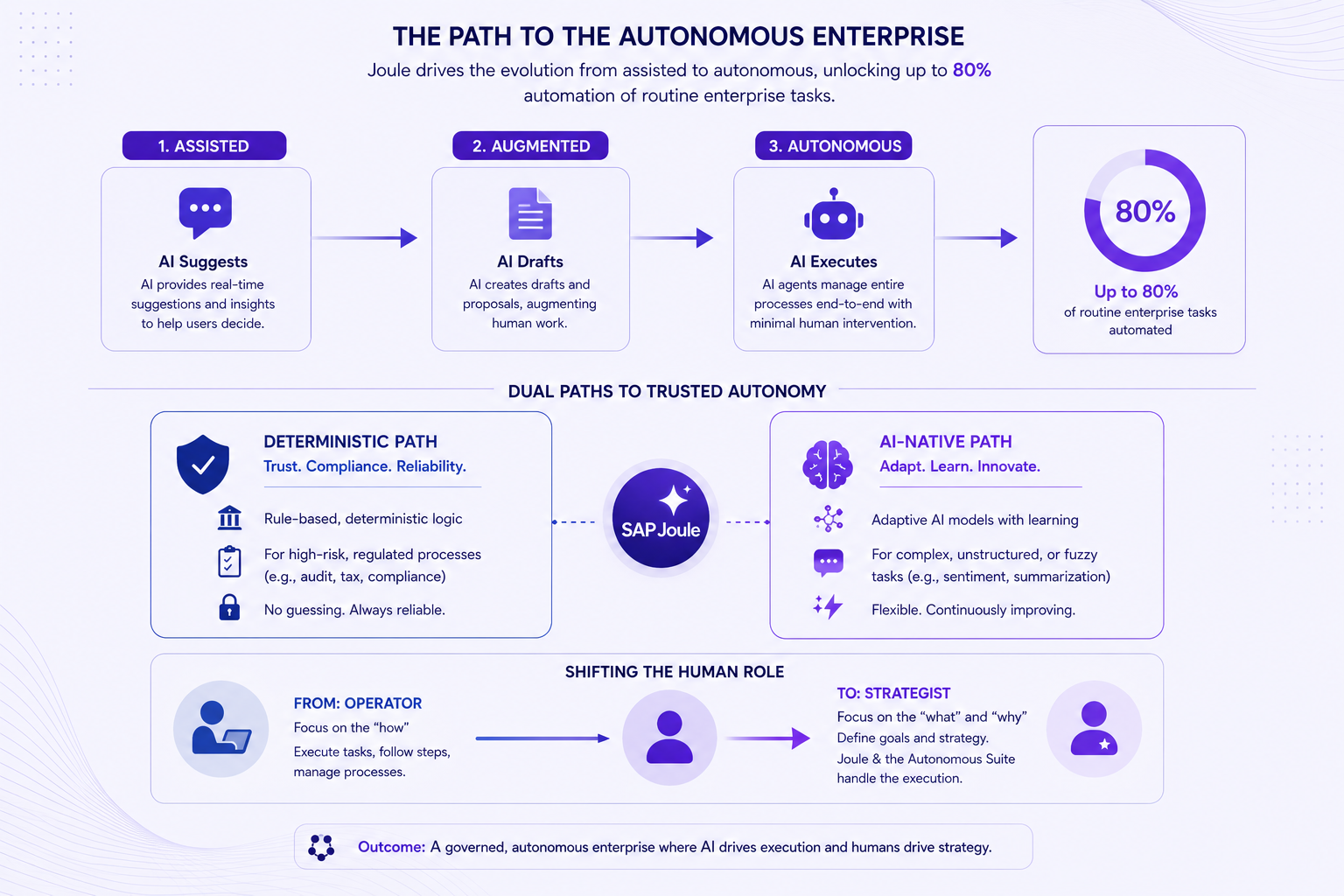
SAP is positioning Joule as the gateway to the Autonomous Enterprise. This is a vision where AI agents manage complex processes across domains—such as Finance, Spend, Supply Chain, HCM, and CX—with minimal manual intervention.
The transition begins with assisted tasks (AI suggesting a response), moves to augmented tasks (AI drafting a report), and culminates in autonomous execution (AI managing a procurement cycle end-to-end). SAP anticipates that this evolution will lead to the automation of up to 80% of routine enterprise tasks.
To ensure this autonomy remains governed, SAP employs “Dual Paths”:
-
The Deterministic Path: Ensures trust and compliance through rigid, reliable rules. There is no “probabilistic” guessing when it comes to auditing or tax calculations.
-
The AI-native Path: Allows for adaptive learning and flexibility, handling “fuzzy” tasks such as analyzing customer sentiment or summarizing complex legal documents.
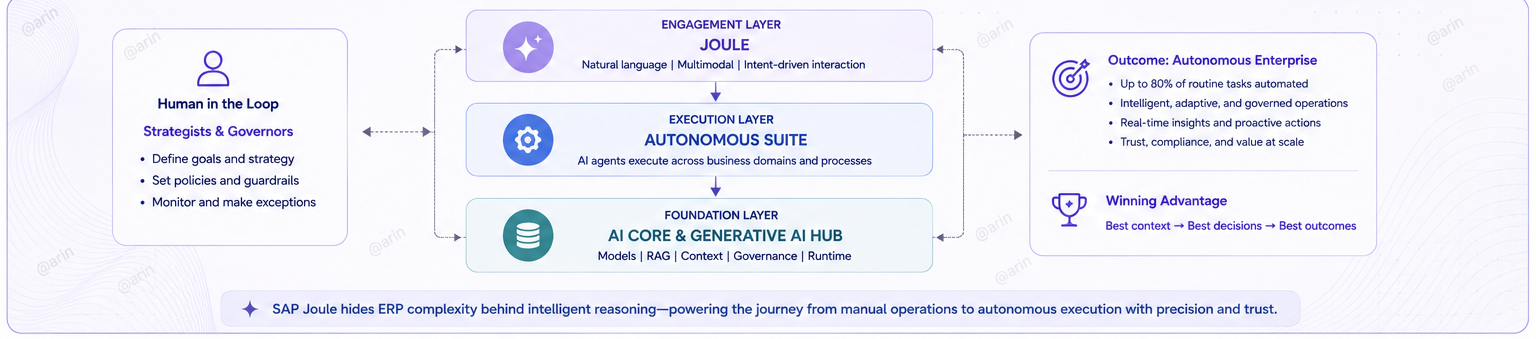
In this world, the human role shifts from “operator” to “strategist,” providing the “what” (the goal) and the “why” (the strategy), while Joule and the Autonomous Suite handle the “how” (the execution).
Section 4: Extending Joule: Joule Studio and AI Agents
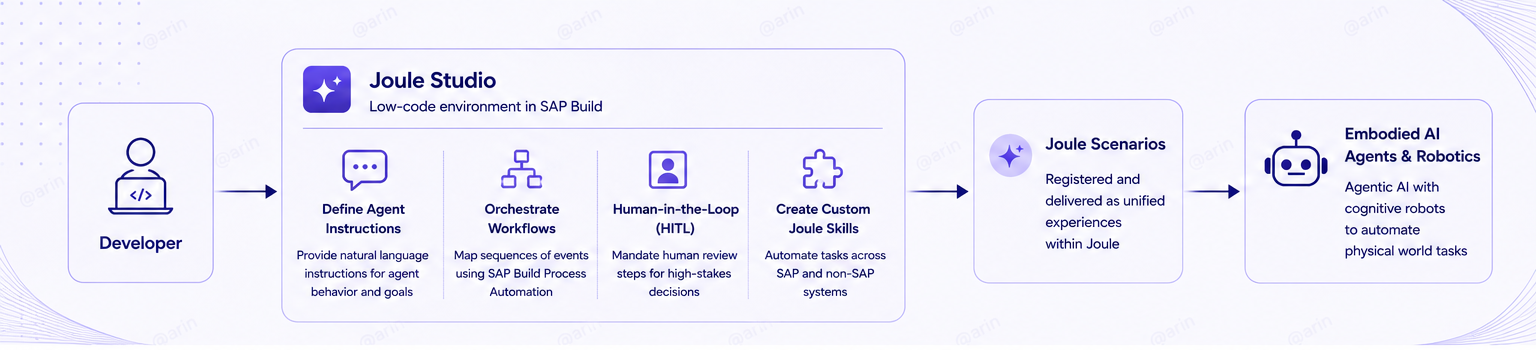
To accommodate unique proprietary processes, SAP provides Joule Studio. This is a low-code visual environment integrated into SAP Build that allows developers to build custom “skills” for Joule. Within Joule Studio, developers can:
-
Define Agent Instructions: Provide natural language instructions telling an agent how to behave and what goals to prioritize.
-
Orchestrate Complex Workflows: Map out sequences of events using tools from SAP Build Process Automation.
-
Specify “Human-in-the-Loop” (HITL) Interactions: Mandate a human review step for high-stakes decisions, ensuring AI does not act without oversight.
-
Create Custom “Joule Skills”: Automate tasks across both SAP and non-SAP systems.
Once developed, these are registered as Joule Scenarios, maintaining a unified user experience. Furthermore, SAP is expanding into Embodied AI Agents & Robotics, combining agentic AI with cognitive robots to automate physical world tasks, such as reorganizing a warehouse layout in real-time based on digital stockout predictions.
Section 5: The Engine Under the Hood: SAP AI Core and Generative AI Hub
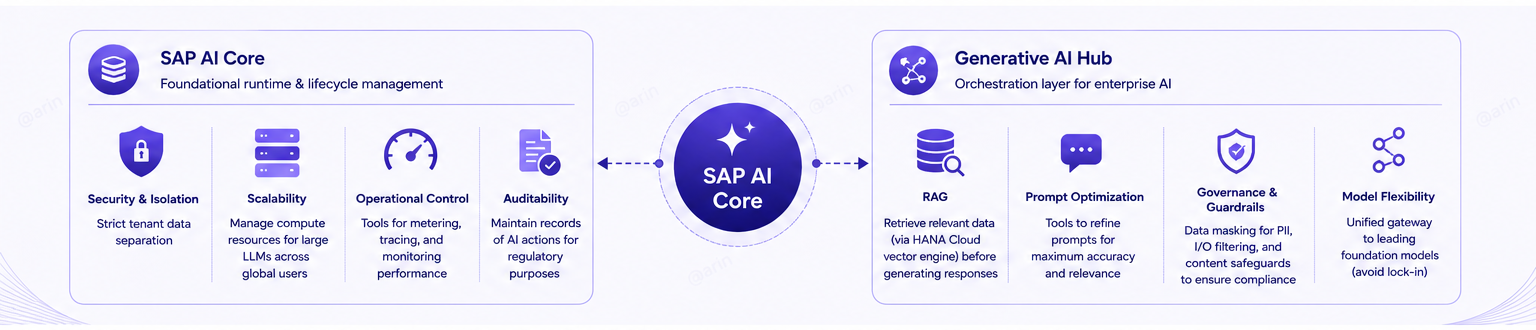
SAP AI Core serves as the foundational runtime and lifecycle management layer [8]. It provides the enterprise-grade plumbing necessary for corporate deployment:
-
Security and Isolation: Ensuring strict tenant data separation.
-
Scalability: Managing compute resources for massive LLMs across global users.
-
Operational Control: Providing tools for metering, tracing, and monitoring performance.
-
Auditability: Maintaining a record of AI actions for regulatory purposes.
Sitting within AI Core is the Generative AI Hub, the orchestration layer that prevents “model lock-in” by providing a unified gateway to various foundation models (e.g., OpenAI, Google, Meta). Key capabilities include:
-
RAG (Retrieval-Augmented Generation): Solves hallucinations by retrieving specific data from the company’s secure database (via vector engines in SAP HANA Cloud) before generating a response.
-
Prompt Optimization: Tools to refine prompts for maximum accuracy.
-
Governance and Guardrails: Implements data masking for PII and I/O filtering to prevent non-compliant content.
Section 6: Deep Dive: The Taxonomy of Joule’s Agentic Capabilities
Joule is a hierarchy of capabilities designed to move from simple chat to complex orchestration.
The Joule Portfolio: Targeted AI Experiences
-
Joule for Business: Focused on operational excellence and real-time insights.
-
Joule for Developers: Assists in writing ABAP or CAP code and deploying AI agents.
-
Joule for Consultants: Accelerates the configuration of SAP systems for implementation partners.
-
n8n Integration: Allows Joule to trigger multi-app external workflows via SAP BTP.
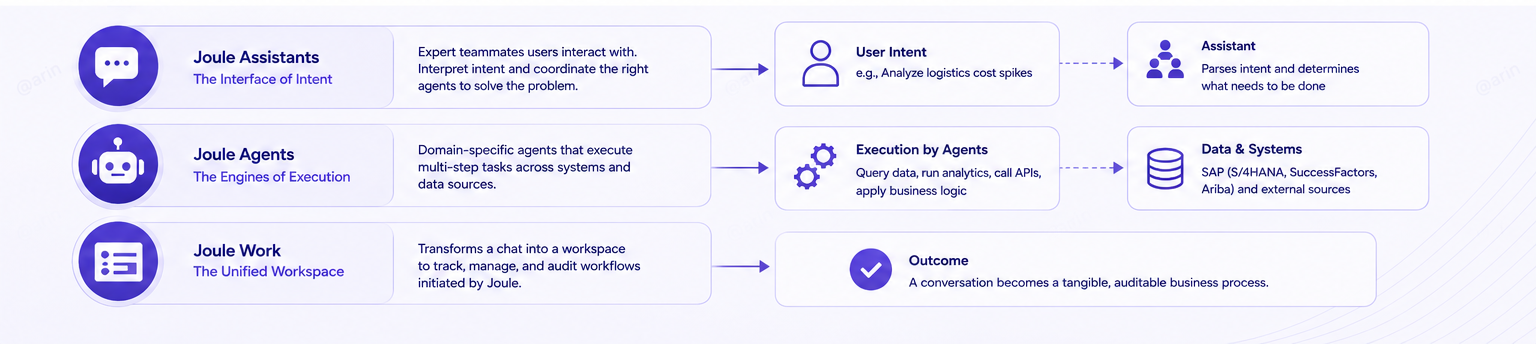
Joule Assistants: The Interface of Intent
These are the “expert teammates” the user interacts with. Their role is to interpret intent. When a user asks to analyze logistics cost spikes, the Assistant parses the intent and coordinates the necessary specialized agents to solve the problem.
Joule Agents: The Engines of Execution
Agents are domain-specific entities capable of executing multi-step tasks. An agent can query the HANA Cloud Vector Engine, extract costs from S/4HANA, cross-reference external APIs, and synthesize a reasoned explanation.
Joule Work: The Unified Workspace
Joule Work transforms a chat window into a workspace. It provides a unified environment where workflows initiated by Joule can be tracked and audited, turning a conversation into a tangible business process.
Section 7: The Intelligence Foundation: From Systems of Record to Systems of Context
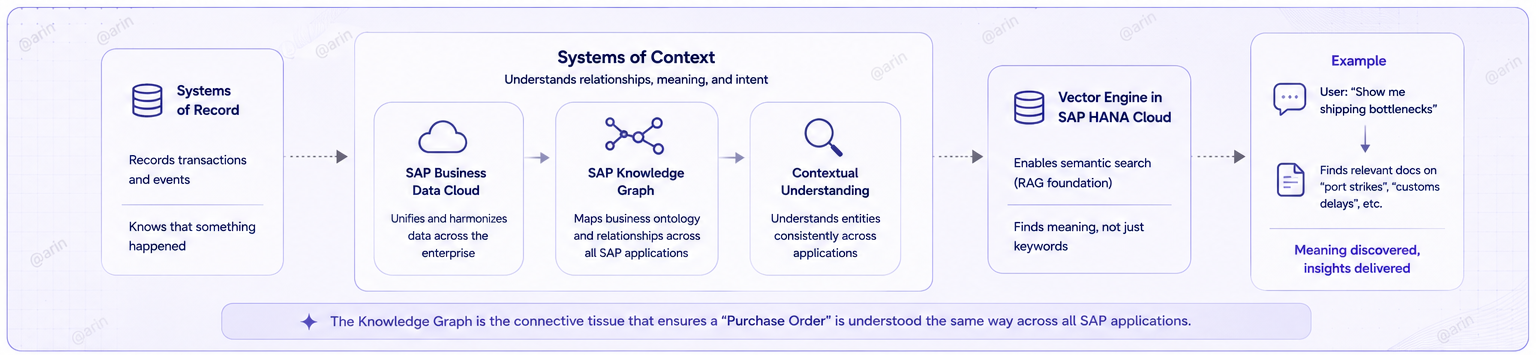
SAP is moving from “Systems of Record” to “Systems of Context”. A traditional system knows a transaction occurred; a System of Context, powered by the SAP Business Data Cloud (BDC) and the SAP Knowledge Graph, understands the relationship between entities.
The Knowledge Graph acts as the connective tissue, mapping the “Business Ontology” across all products. This ensures that an AI agent understands a “Purchase Order” the same way in S/4HANA as it does in SuccessFactors.
To enable this, SAP integrated Vector Engines into SAP HANA Cloud. This enables semantic search—looking for meaning rather than keywords. If a user asks about “shipping bottlenecks,” the engine finds documents on “port strikes” even if the word “bottleneck” is absent, providing the bedrock for RAG.
Section 8: Governance, Trust, and the “Nonnegotiable” Standard
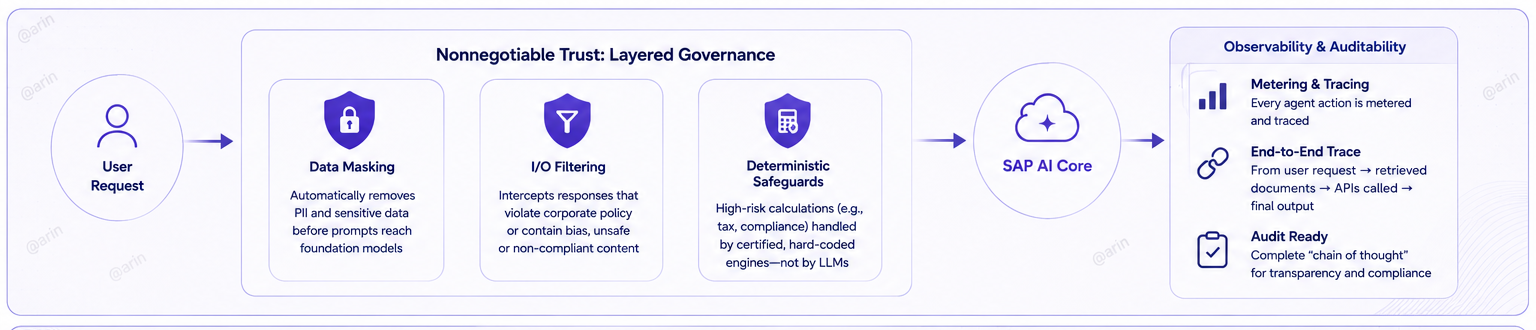
SAP emphasizes Nonnegotiable Trust through a layered framework:
-
Data Masking: Automatically removes PII before prompts reach a foundation model.
-
I/O Filtering: Intercepts responses that violate corporate policy or contain bias.
-
Deterministic Safeguards: High-risk calculations (e.g., tax) are handled by certified, hard-coded engines rather than generative models.
Observability is handled via metering and tracing in SAP AI Core. Every agent action creates a trace, allowing auditors to reconstruct the “chain of thought”: from the initial user request and the RAG documents retrieved to the specific API called and the final output.
Section 9: Summary of the AI-Native Architecture
The evolution of SAP Joule represents a blueprint for the future of business. By integrating the engagement layer (Joule), the execution layer (Autonomous Suite), and the foundation layer (AI Core and Generative AI Hub), SAP hides ERP complexity behind intelligent reasoning.
As task-specific AI agents become a competitive necessity, the organization that wins will be the one with the best context. SAP provides the roadmap to evolve from manual operations to an autonomous state, where humans operate as strategists and governors, while Joule and the Autonomous Suite handle the execution with unprecedented precision and trust.