Navigating the North Star: SAP’s Blueprint for the Autonomous Enterprise

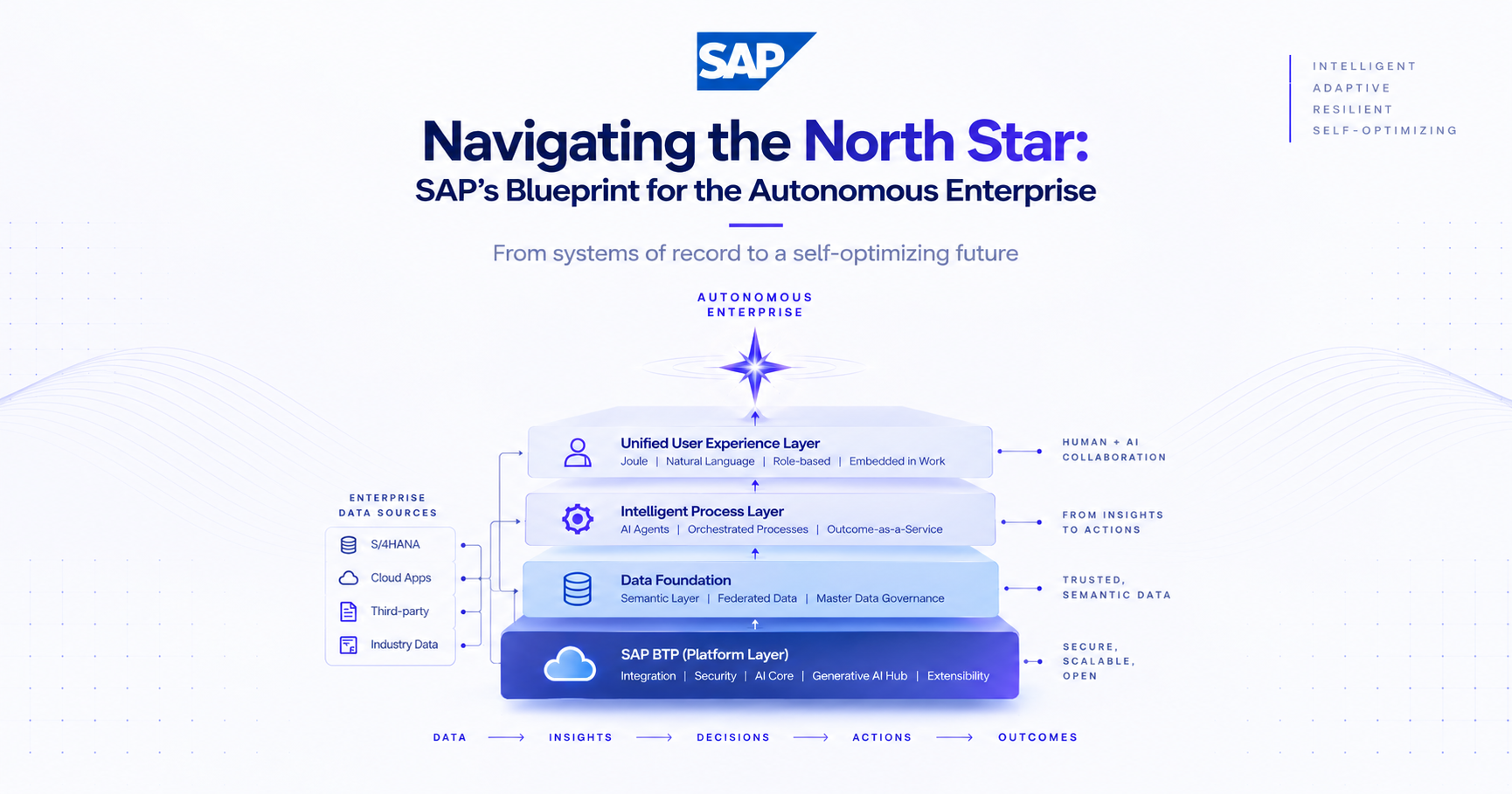
The landscape of Enterprise Resource Planning (ERP) is undergoing a fundamental metamorphosis. For decades, ERP systems served as the “system of record”—vast repositories of data designed to track transactions and ensure consistency. However, the emergence of Business AI is shifting the paradigm from systems that merely record history to systems that actively shape the future.
At the center of this evolution is the SAP North Star Architecture, a strategic framework designed to transition organizations from traditional ERP environments to the “Autonomous Enterprise.”
The Architectural Shift: From Static Record to Dynamic Intelligence
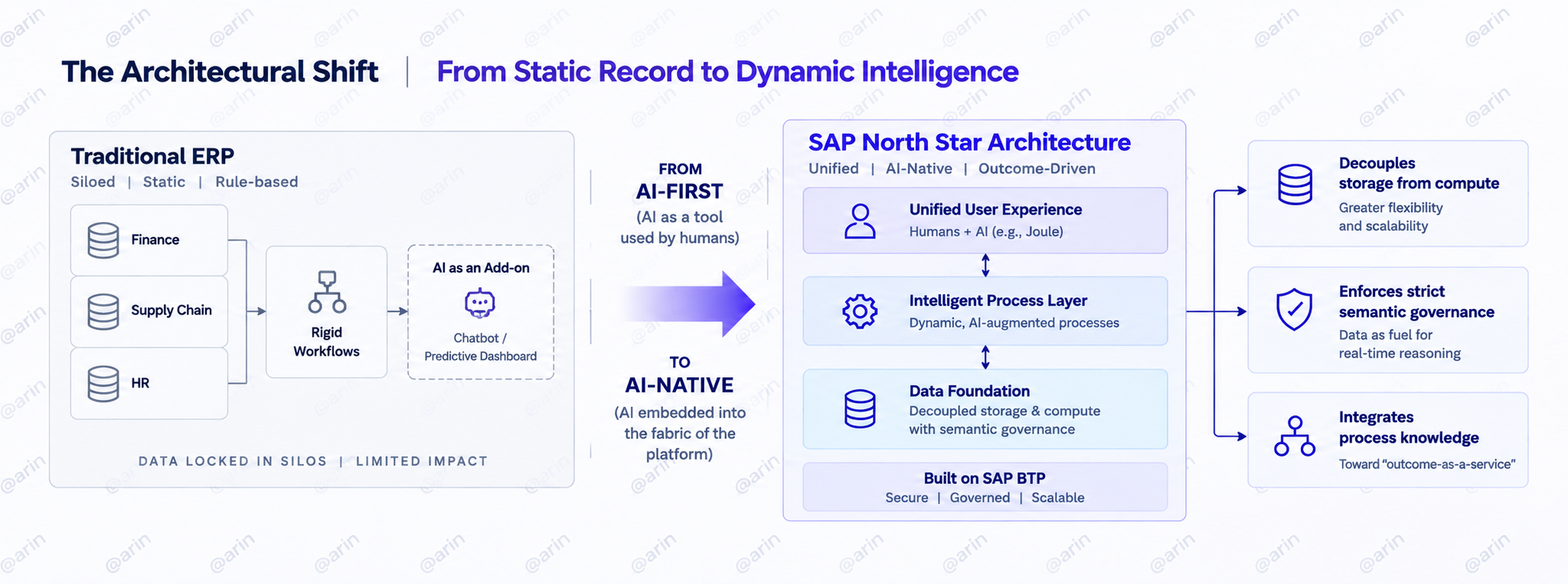
The journey toward an autonomous enterprise requires more than just adding AI features to existing software; it demands a systemic architectural overhaul. Traditional ERP architectures are often siloed, with data locked in proprietary tables and processes executing via rigid, predefined workflows. In this legacy model, AI is typically an “add-on”—a chatbot or a predictive dashboard that exists on the periphery of the actual business process.
The North Star Architecture replaces this fragmented approach with an AI-native foundation. The shift is characterized by a transition from “AI-first” (where AI is a tool used by humans) to “AI-native” (where AI is embedded into the fabric of the platform). This new architecture:
- Decouples storage from compute: Allowing for greater flexibility and scalability.
- Enforces strict semantic governance: Ensuring that data is not treated as a static asset but as the fuel for real-time reasoning.
- Integrates process knowledge: Moving toward “outcome-as-a-service,” where the system is measured not by the software it provides, but by the business results it autonomously achieves.
The Four Pillars of the North Star Architecture
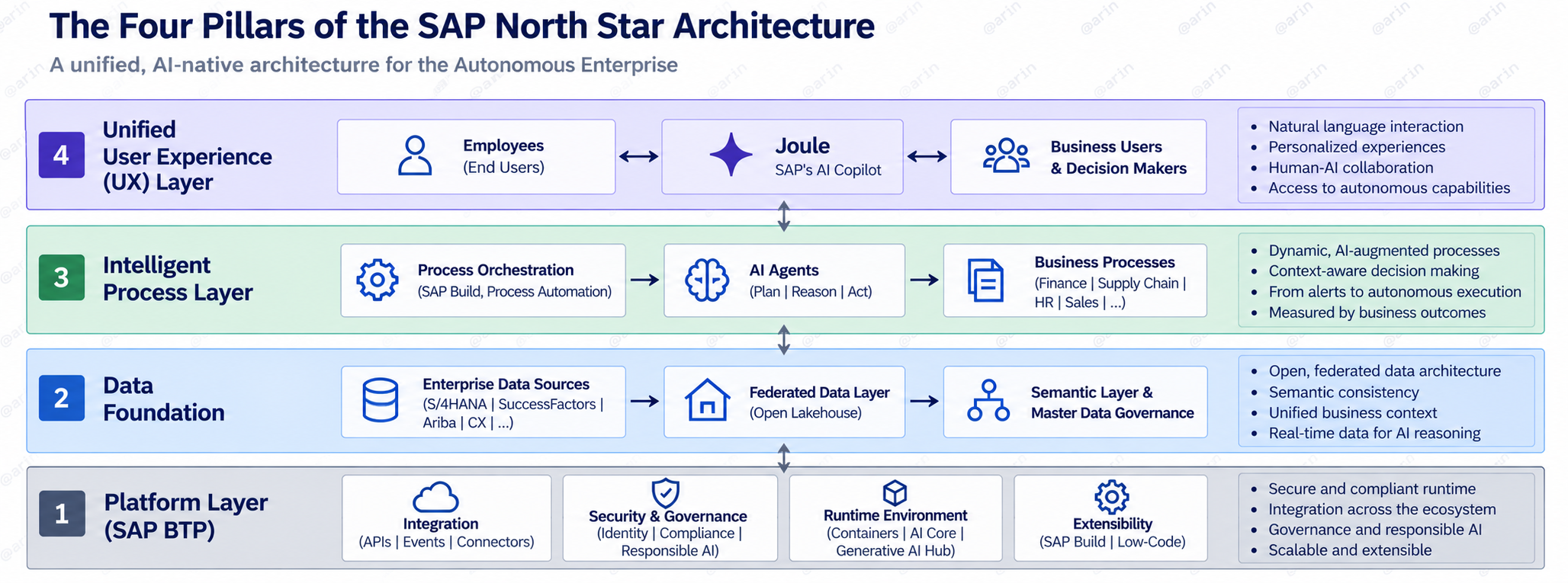
To realize the vision of the Autonomous Enterprise, the North Star Architecture organizes the enterprise ecosystem into four interdependent layers:
1. The Platform Layer (SAP BTP)
The foundation of the entire structure. The SAP Business Technology Platform (BTP) provides the runtime environment, security, and integration capabilities. BTP ensures that AI agents operate within a governed, compliant, and secure sandbox, preventing “hallucinations” from impacting core financial or operational data.
2. The Data Foundation
A robust, federated data layer leveraging open-standard lakehouses and advanced master data governance. By prioritizing semantic consistency, SAP ensures that AI agents understand the meaning of the data (e.g., knowing that a “customer” in the CRM is the same entity as a “debtor” in Finance), which is critical for accurate reasoning across the value chain.
3. The Intelligent Process Layer
This layer transforms static workflows into dynamic processes. Here, AI doesn’t just alert a human to a problem; it analyzes the context, refers to historical decision patterns, and proposes or executes a resolution.
4. The Unified User Experience (UX) Layer
The interface where humans and AI collaborate. This is personified by Joule, SAP’s AI copilot, which acts as the primary entry point for users to interact with the autonomous capabilities of the system through natural language.
Integrating Generative and Agentic AI
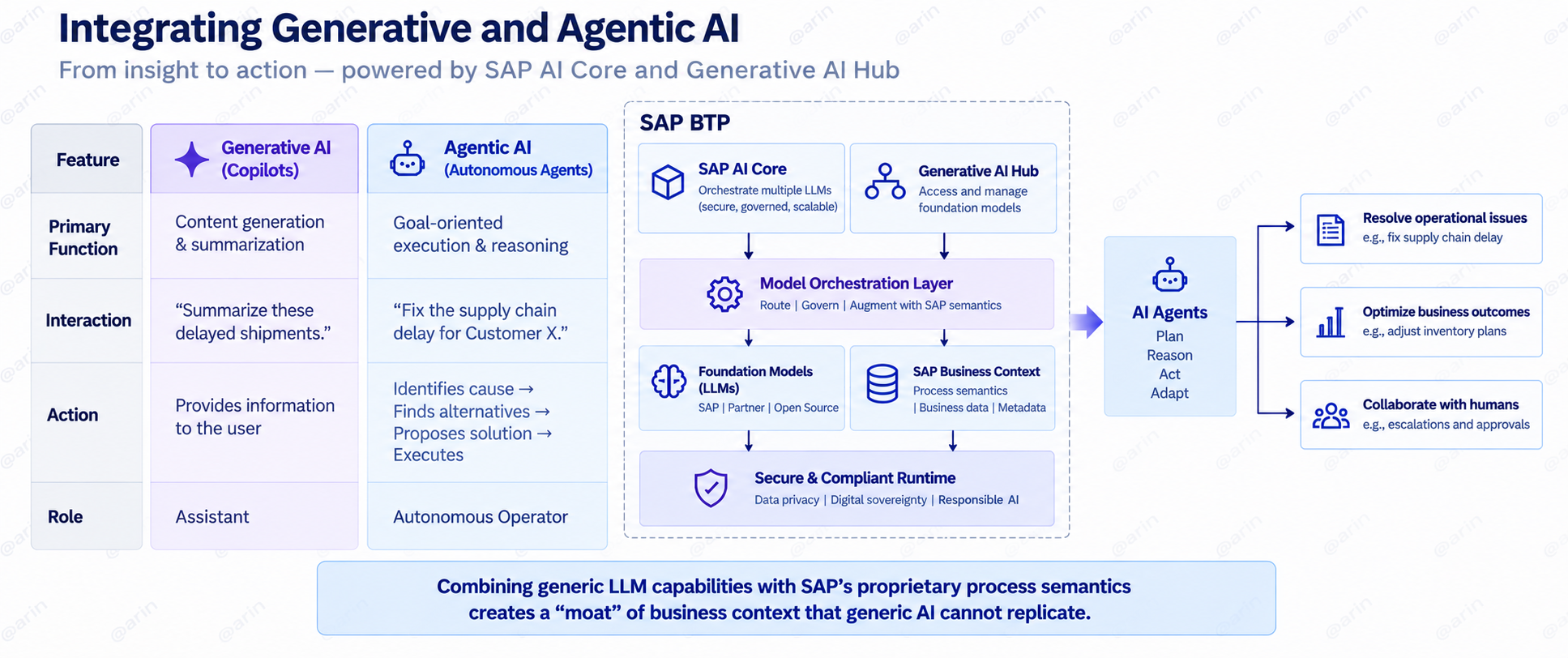
The true power of the North Star Architecture lies in its move toward Agentic AI. While generative AI excels at creating content or summarizing data, agentic AI can plan, act, and adapt.
| Feature | Generative AI (Copilots) | Agentic AI (Autonomous Agents) |
|---|---|---|
| Primary Function | Content generation & summarization | Goal-oriented execution & reasoning |
| Interaction | “Summarize these delayed shipments.” | “Fix the supply chain delay for Customer X.” |
| Action | Provides information to the user | Identifies cause → Finds alternatives → Proposes solution → Executes |
| Role | Assistant | Autonomous Operator |
This integration is made possible through the SAP AI Core and the Generative AI Hub on BTP, which allow the enterprise to orchestrate multiple large language models (LLMs) while maintaining strict data privacy and digital sovereignty. By combining generic LLM capabilities with SAP’s proprietary process semantics, the architecture creates a “moat” of business context that generic AI cannot replicate.
Business Outcomes: The ROI of Autonomy
The evolution toward a North Star Architecture is driven by three primary business imperatives:
- Hyper-Efficiency: By automating complex, multi-step cognitive tasks, the autonomous enterprise reduces “operational friction.” Processes that once took days of cross-departmental coordination can now be resolved in seconds by autonomous agents.
- Adaptive Agility: Traditional ERPs are often brittle; changing a process requires extensive reconfiguration. An AI-native architecture allows the business to pivot in real-time. Agentic AI can detect market shifts or supply chain disruptions and automatically suggest operational adjustments to mitigate risk.
- Infinite Scalability: As the system takes over the burden of routine decision-making, the organization can scale its operations without a linear increase in administrative headcount. The focus shifts from “managing the system” to “steering the strategy.”
Conclusion
The SAP North Star Architecture is more than a technical roadmap; it is a blueprint for the future of work. By moving from a fragmented ERP model to a unified, AI-native platform anchored by SAP BTP, organizations can finally bridge the gap between data and action. The transition to an Autonomous Enterprise will be a gradual journey, requiring a relentless focus on data cleanliness and governance, but the destination is clear: a business that is not only intelligent but truly self-optimizing.