Chapter 05 of 16 · 3 min · 31% through
Asking well
A system with many ways to find things is tempted to use all of them on every question. That feels rigorous. In practice it is the opposite: slower, more expensive, noisier, and it gives every question more chances to drift away from what a person actually keeps.
So effort is treated as something a question has to earn. A question the corpus plainly answers should be answered from it, cheaply. A question about how things connect deserves the map. And a question that genuinely turns on what is true today — or that the corpus simply does not cover — is the one that has earned a trip outside the house. The decision is made before any expensive model call, not after.
Fig. 4.1 — The smallest justified path: decide before you spend.
A retrieval system should be judged by what it refuses to retrieve.
If a trip outside the house cannot happen — no connection, no allowance, no answer — the reply is still built from a person’s own material, and the failure is disclosed rather than hidden. That is a deliberate property, not a fallback born of necessity: the goal is not maximum external knowledge, which anyone can get from a search engine. The goal is correctly selected knowledge, reached by the shortest route that can be justified. Every unnecessary search adds delay, cost, noise, and one more opportunity for the answer to be about something other than what a person actually owns.
When the corpus says nothing
The honest case is more instructive than the flattering one. The panel below is from an actual run, asked a plain technical question about a Python networking library — something the corpus in question had simply never covered.
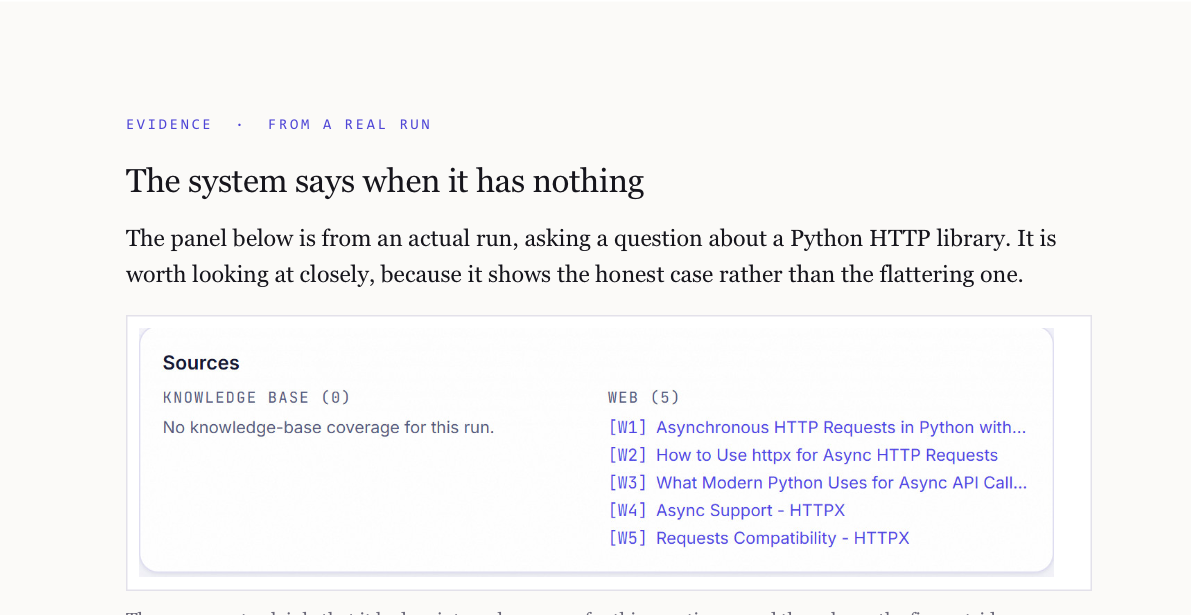
The run does not pad its answer with loosely related internal material to look better grounded than it is. It states plainly that the shelf was empty, and only then goes looking outside — and what comes back stays labelled as outside material rather than blended silently into the rest.
The admission — No knowledge-base coverage for this run. The system says the shelf was empty rather than reaching for something adjacent.
The consequence — Going outside was earned by the absence, not by habit — and everything that came back stayed cited as outside material.
An assistant that cannot tell you when it is guessing is not saving you work. It is moving the work to the point where you have to check everything.