Chapter 02 of 16 · 2 min · 13% through
From tools to a system — a short recap
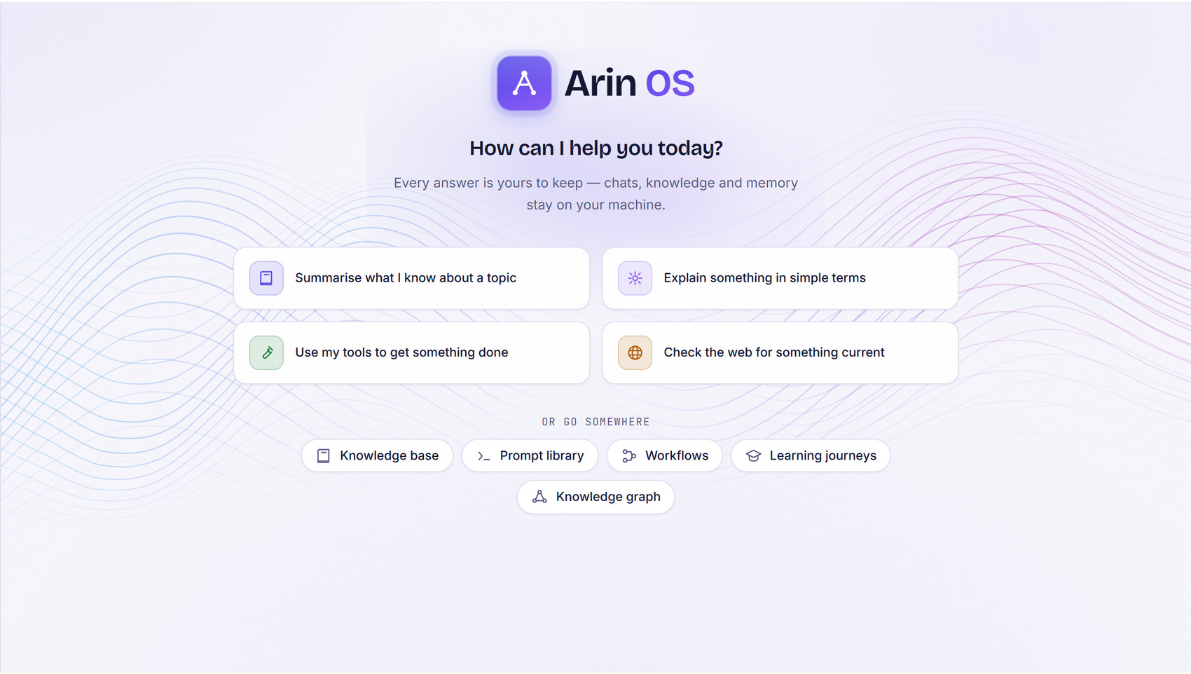
The first version of Arin OS answered a basic question: what does a self-hosted personal AI environment need to be useful every day? It supplied the building blocks — a way to bring knowledge in, a way to search it, a map of how ideas connect, a chat surface, workflows, learning journeys, notes, backups, interview preparation. Each solved a real problem on its own. Before they were linked, each surface also kept its own small, separate memory — four doors, four different ideas of “remembering,” none talking to the others.
What this version changed was not the parts. It was what happens between them: the same building blocks, now aware of one another and drawing on one shared memory, so a fact surfaced in chat is already available to a workflow, and a workflow’s findings can seed a learning journey — without anything being retyped or exported by hand.
Version 1 · the substrate — Capable parts, side by side. You chose which part to open, and carried the context between them yourself.
Version 2 · the linkage — The same parts, aware of one another. The system works out which of them a task needs, and in what order — so you state the goal, not the route.
That sounds like a subtle change, but it is the essence of an agentic system. A capability is valuable only when the whole recognises when it should be used, refuses it when it should not, and combines it with other capabilities when a task needs more than one kind of evidence. The move was not adding more buttons. It was making the parts aware of one another — without turning the whole application into an uncontrolled agent.